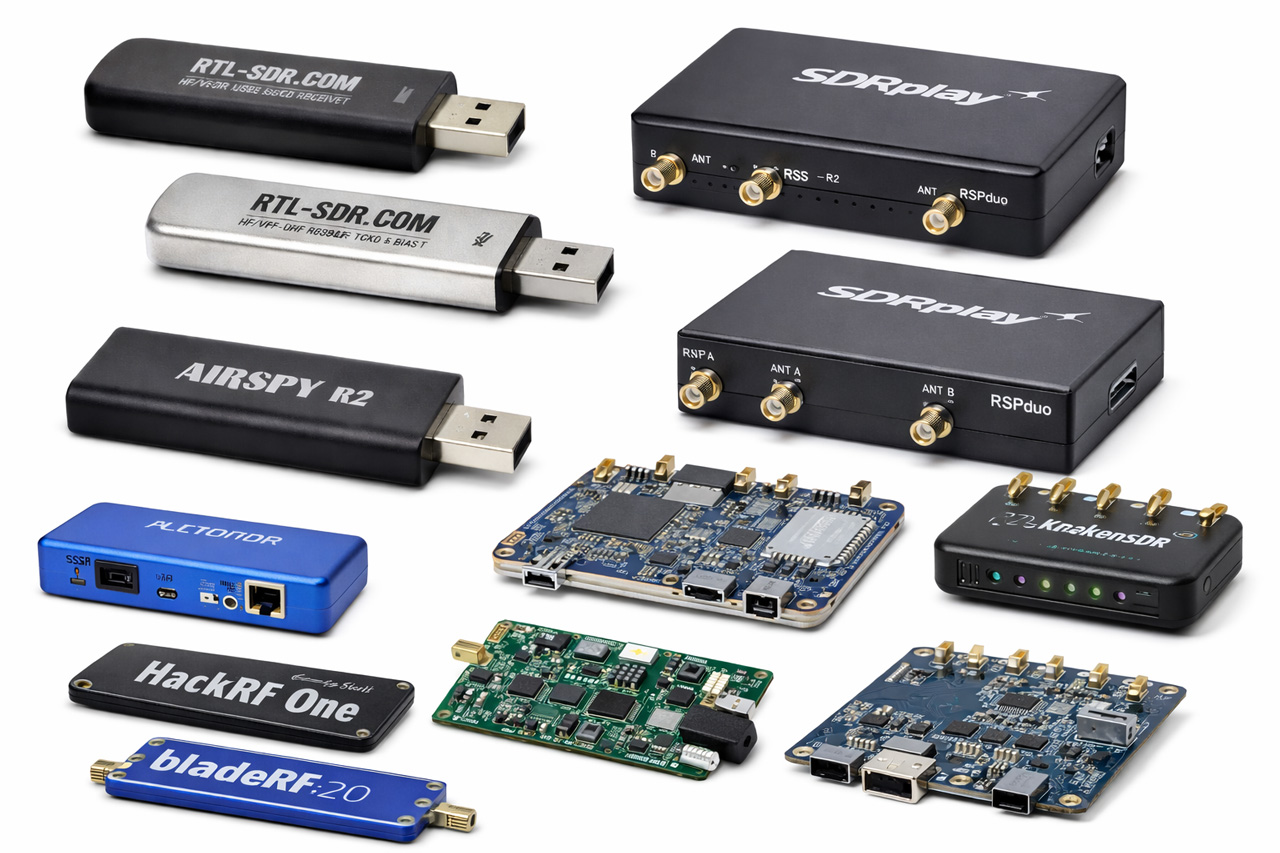
Software Defined Radio (SDR) has transformed the radio hobby. What once required racks of analog hardware can now be done with a small USB dongle, a laptop, and open-source software. But as the market has matured, the choices have multiplied — from sub-$30 dongles to $1,000+ research-grade platforms. This guide covers every major SDR available to amateur radio operators and hobbyists, with detailed comparisons of hardware specifications, programming APIs, supported applications, and real-world performance.
A note on scope: this article covers SDRs that are purchasable and actively supported as of mid-2025. Discontinued models (RTL-SDR V3 predecessors, original LimeSDR, RSP1/RSP1A, original KerberosSDR, etc.) are noted where relevant for context, but the focus is on hardware you can actually buy today.
Table of Contents
- Understanding SDR Hardware Fundamentals
- The SDR Landscape at a Glance
- Device-by-Device Technical Profiles
- Specifications Comparison Table
- Programming APIs and Language Support
- Supported Applications Comparison
- Performance Comparison
- Use-Case Decision Guide
- Price vs. Capability Summary
- Conclusions
1. Understanding SDR Hardware Fundamentals
Before diving into comparisons, it helps to understand what the key specifications actually mean for your use case.
Frequency Range is the span of radio frequencies the SDR can tune to. A wider range means you can receive (and possibly transmit) more types of signals. Most inexpensive SDRs cover VHF/UHF but not HF; specialist HF-focused receivers like the Airspy HF+ Discovery cover only a narrow range but do it exceptionally well.
ADC Resolution (bit depth) determines the dynamic range of the receiver. Higher bit depth means a larger difference between the weakest and strongest signal the device can handle simultaneously without either losing the weak signal in noise or overloading on the strong one. For example, an 8-bit ADC has about 48 dB of theoretical dynamic range, a 12-bit ADC has about 72 dB, and a 14-bit ADC has about 84 dB. Real-world ENOB (Effective Number of Bits) is always lower due to noise, but the principle holds.
Sample Rate / Instantaneous Bandwidth determines how wide a slice of spectrum you can view and record at once. A 2 MHz sample rate shows 2 MHz of spectrum; a 56 MHz sample rate can display an entire cellular band simultaneously. Higher sample rates demand faster USB/network interfaces and more powerful host CPUs.
Noise Figure (NF) measures how much noise the receiver itself adds to a signal. Lower is better. A typical RTL-SDR has a noise figure around 5–7 dB; professional USRPs approach 5–8 dB but with better dynamic range management; dedicated HF receivers like the Airspy HF+ Discovery achieve sub-4 dB figures on HF bands.
Full Duplex vs. Half Duplex: Full duplex means you can transmit and receive simultaneously on different frequencies (required for MIMO, repeaters, some protocols). Half duplex means you can only do one at a time (HackRF One is half duplex). Most amateur applications only need half duplex.
TX/RX: Many SDRs are receive-only. Those that can transmit open up applications like amateur digital modes, signal injection, waveform testing, and education. Transmitting on licensed frequencies requires the appropriate amateur radio licence.
FPGA vs. No FPGA: Some SDRs have an onboard FPGA that can perform signal processing before data reaches the host PC, allowing higher effective sample rates and more complex on-device processing. RTL-SDR and simple Airspy models have no FPGA; the ADALM-Pluto, LimeSDR, BladeRF and USRP all have one.
MIMO: Multiple-Input Multiple-Output operation requires at least two coherent RX/TX chains. Useful for diversity reception, spatial multiplexing research, and experimental cellular work. The USRP B210, BladeRF 2.0 micro, and LimeSDR family all support 2×2 MIMO natively.
2. The SDR Landscape at a Glance
SDRs for amateur use roughly fall into five tiers:
Tier 1 — Entry Level RX Only (<$50): RTL-SDR V4 dongle. Enormous community, limited dynamic range and frequency range. Perfect starting point.
Tier 2 — Prosumer RX Only ($100–$250): Airspy R2, Airspy Mini, Airspy HF+ Discovery, SDRplay RSP1B, SDRplay RSPdx-R2, SDRplay RSPduo. Significantly better performance than RTL-SDR, still receive-only, broad software support.
Tier 3 — Entry Transceiver ($100–$350): ADALM-Pluto (PlutoSDR), HackRF One. TX capability opens new project possibilities. Limited bandwidth and ADC depth compared to higher tiers.
Tier 4 — Mid-Range MIMO/Research ($400–$700): LimeSDR Mini 2.0, BladeRF 2.0 micro, Fairwaves XTRX. FPGA-equipped, MIMO capable, wide bandwidth, open hardware.
Tier 5 — Professional Research ($700+): Ettus USRP B200, B210, N-series. Industry standard, outstanding driver support, best-in-class research pedigree. High cost.
Specialist: KrakenSDR (5-channel coherent RX for direction finding). Not a general-purpose SDR but unique in its application domain.
3. Device-by-Device Technical Profiles
RTL-SDR Blog V4 (RTL2832U / R828D)
The RTL-SDR is the device that democratized software defined radio. Originally a DVB-T TV tuner dongle, the accidental discovery that its RTL2832U chipset exposed raw IQ samples launched an entire ecosystem. The current version, the RTL-SDR Blog V4, uses the R828D tuner instead of the older R820T2, adding native HF coverage from roughly 500 kHz upward (the older V3 required a hardware “direct sampling” hack for HF). It connects via USB 2.0 and streams up to about 2.56 MHz of stable bandwidth, though the hardware technically supports up to 3.2 MHz with some dropped samples.
The ADC is 8-bit, giving it the lowest dynamic range of any device in this list. This is its primary weakness: in the presence of strong signals (broadcast FM, nearby transmitters), it can be easily overloaded. The RSP1B or Airspy are significant upgrades in this regard. Nevertheless, for many common amateur tasks — ADS-B aircraft tracking, weather satellite reception, meteor scatter, FM/DAB listening, scanning repeaters — the RTL-SDR V4 performs entirely adequately.
The V4 adds a 4.5V bias tee (software switchable) for powering LNAs, a 1 PPM TCXO for improved frequency stability, and an ESD-protected SMA port. Price is typically $30–$40 from the official RTL-SDR Blog store or Amazon, often sold as a kit with a dipole antenna. The open-hardware design has spawned a huge third-party accessory ecosystem.
Airspy R2
The Airspy R2 is the flagship VHF/UHF receiver from Airspy. It uses a Rafael Micro R820T2 tuner paired with a quality 12-bit oversampling ADC, delivering genuine improvement over the RTL-SDR in both noise figure and dynamic range. In oversampling mode (10 MSPS raw, decimated), it achieves up to 16-bit effective resolution within a 10 MHz visible window, eliminating the IQ imbalance, DC offset, and 1/f noise that plague RTL-SDRs. It supports a 10 MHz instantaneous bandwidth at its native 10 MSPS rate.
The Airspy R2 does not cover HF by default. Coverage is 24–1800 MHz. For HF, a companion upconverter (SpyVerter R2, ~$60) is available. A microUSB port provides both power and data, and an MCX connector allows an external reference clock. The device is receive-only. It connects via USB 2.0 but the USB bandwidth is sufficient given the 10 MSPS throughput. Bias tee power is available for LNAs. Price is approximately $169.
Airspy Mini
A smaller, cheaper sibling to the Airspy R2. It shares the same core architecture but offers a 6 MHz maximum bandwidth. Coverage is 24–1800 MHz, same as the R2. Price is approximately $99. For users who don’t need the full 10 MHz window of the R2, the Mini delivers essentially the same performance in a more compact form factor. Both devices work with the same driver ecosystem.
Airspy HF+ Discovery
Purpose-built for HF and lower VHF excellence, the HF+ Discovery is a fundamentally different design from the R2. It covers 0.5 kHz to 31 MHz (HF/LF/MF) and 60–260 MHz (VHF), with nothing in between. It uses a zero-IF architecture with harmonic rejection mixers and multiple analog tuners, plus polyphase harmonic rejection and band-tracking preselectors for exceptional strong-signal handling. The DSP core continuously optimizes gain distribution and filtering parameters in real time.
Dynamic range and sensitivity are exceptional for the price — comparable in practice to receivers costing many times more on HF. Amateur radio operators interested in HF monitoring, shortwave listening, standard frequency reception, or ionospheric work will find this is the best receiver under $200 for those purposes. It is receive-only, USB 2.0 powered, with a microUSB data/power port. Price is approximately $169.
SDRplay RSP1B
The RSP1B is SDRplay’s current entry-level device, replacing the discontinued RSP1A (which itself replaced the RSP1 in 2017). It covers 1 kHz to 2 GHz continuously — one of the widest ranges of any device at this price point. It uses a 14-bit ADC (the highest resolution of any mass-market hobbyist SDR) and supports up to 10 MHz of instantaneous bandwidth.
The RSP1B features 11 hardware band-pass filters and 3 notch filters (FM, MW, and DAB broadcast rejection), which substantially help with dynamic range in real-world environments. The built-in LNA improves weak-signal sensitivity. It is receive-only, USB 2.0 connected, and comes bundled with SDRuno (Windows) and SDRconnect (Windows/macOS/Linux including Raspberry Pi) free of charge. Price is approximately $133 USD / £106 GBP.
SDRplay RSPdx-R2
The RSPdx-R2 is an enhanced version of the RSPdx, redesigned partly due to component supply issues. It adds three software-selectable antenna inputs (ANT-A: 1 kHz–2 GHz; ANT-B: 1 kHz–2 GHz; ANT-C: 200 MHz–2 GHz) and a special HDR (High Dynamic Range) mode for frequencies below 2 MHz that significantly improves low-frequency performance. Frequency coverage is 1 kHz–2 GHz, same as RSP1B. The component redesign in the R2 revision also yielded improved noise performance below 1 MHz. It is receive-only, USB 2.0. Price is approximately $199 USD / £160 GBP.
SDRplay RSPduo
The RSPduo is SDRplay’s unique dual-tuner device. It contains two independent receiver chains, each covering 1 kHz to 2 GHz, which can be used simultaneously. This enables diversity reception (combining two antenna feeds to combat fading), simultaneous monitoring of two completely separate frequency bands (up to 2 MHz bandwidth each, simultaneously), or a combined single high-bandwidth 10 MHz mode. It is receive-only, USB 2.0, and 14-bit. Particularly useful for shortwave DXing with diversity antennas. Price is approximately $279 USD / £220 GBP.
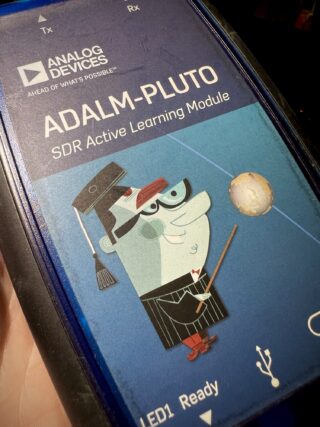
ADALM-Pluto (PlutoSDR)
The ADALM-Pluto (Active Learning Digital Module) from Analog Devices is one of the most educationally popular SDR transceivers available. It is based on the AD9363 RF transceiver chip and a Xilinx Zynq Z-7010 SoC (which combines an ARM Cortex-A9 CPU with an FPGA fabric), runs Linux internally, and presents itself as a USB gadget. The nominal frequency range is 325 MHz to 3.8 GHz, but with unofficial firmware modifications the AD9363 can be unlocked to approximately 70 MHz–6 GHz with degraded but usable performance. MIMO is not officially supported (the AD9363 is a 1×1 chip), though Rev. D boards expose the second TX/RX pair to U.FL connectors.
The Pluto connects via USB 2.0 (OTG), which limits practical sample rates to about 4–5 MSPS in Python (though the hardware supports up to 61.44 MSPS internally). It can also be accessed over Ethernet via its USB-Ethernet gadget mode or a direct Ethernet connection (on some models). The Analog Devices ecosystem around the Pluto is outstanding for education and MATLAB/Python work — the libiio / pyadi-iio toolchain provides one of the cleanest SDR programming interfaces available. Price is approximately $149–$229 USD depending on supplier; Pluto+ clones are available from Chinese manufacturers for $80–$120 with extended frequency coverage.
HackRF One
Great Scott Gadgets’ HackRF One is the most widely known wideband transceiver SDR for hacking and research. It covers 1 MHz to 6 GHz and uses an 8-bit ADC, making it the widest-range consumer SDR available at a moderate price. The key limitation is that it is half-duplex only (cannot TX and RX simultaneously) and the 8-bit ADC gives it modest dynamic range. Input overpower protection is limited — the maximum safe input is around 0 dBm (–10 dBm is recommended), and the power amplifier on the TX path is susceptible to damage from antenna mismatch.
It connects via USB 2.0 and supports up to 20 MSPS. An optional PortaPack H2 add-on turns it into a standalone handheld transceiver with screen and controls. The Opera Cake board provides switchable antenna selection. It is fully open hardware and open source firmware. Official price is approximately $340 USD; many compatible clones exist at $90–$150 with varying quality. The clone market means build quality can be inconsistent.
LimeSDR Mini 2.0
The LimeSDR Mini 2.0 is Lime Microsystems’ current USB stick SDR, replacing the supply-challenged original Mini. It retains the LMS7002M RF transceiver (the same core chip in all LimeSDR products) but upgrades the FPGA to a Lattice ECP5 (44K logic gates, fully open-source toolchain via nextpnr/yosys). Frequency coverage is 10 MHz to 3.5 GHz, maximum bandwidth is 40 MHz, and it supports 1×1 TX/RX (not MIMO, despite having two physical ports). It connects via USB 3.0. The ADC is 12-bit.
The price jump from the original ($139) to the 2.0 ($399) has been controversial in the community, placing it in awkward competition with the BladeRF 2.0 micro. The ECP5 FPGA’s open-source toolchain is a genuine advantage for academic and advanced users who want to implement custom FPGA logic. The LimeSuite driver and SoapySDR plugin provide broad software compatibility. Note that the original LimeSDR (2×2 MIMO, 61.44 MHz bandwidth) has been discontinued.
BladeRF 2.0 micro (xA4 and xA9)
The BladeRF 2.0 micro from Nuand is a well-rounded MIMO-capable transceiver in a compact form factor. It covers 47 MHz to 6 GHz, supports 2×2 MIMO with full duplex operation, and achieves up to 61.44 MSPS. It uses an Analog Devices AD9361 transceiver (the same chip as the USRP B210) with a Cyclone V FPGA (55K LEs on the xA4, 301K LEs on the premium xA9). All sources — FPGA HDL, firmware, and schematics — are open source.
The xA4 is the standard model; the xA9’s 301K LE FPGA has substantially more room for custom signal processing accelerators (FFTs, turbo decoders, etc.), making it more suitable for advanced DSP research. It connects via USB 3.0 SuperSpeed. Support is available for Linux, macOS, and Windows. Price is approximately $540 (xA4) and $665 (xA9). The BladeRF 2.0 is generally considered better value than the LimeSDR Mini 2.0 at similar price points given the 2×2 MIMO capability and wider frequency coverage.
Ettus USRP B200 / B200mini / B210
The Ettus Research USRP (Universal Software Radio Peripheral) platform is the industry standard for academic and professional SDR research. The B-series are the USB-connected models. The B200 is a 1×1 (1 TX, 1 RX) device; the B210 is a 2×2 MIMO device using both chains of the AD9361. Both cover 70 MHz to 6 GHz continuously. The B200mini is a compact business-card-sized 1×1 version. The newer B206mini replaces the older B205mini.
The FPGA is a Xilinx Spartan-6 XC6SLX150 (B210), connected to the host via USB 3.0 SuperSpeed. Maximum real-time bandwidth is 56 MHz (61.44 MSPS). The USRP Hardware Driver (UHD) is mature, well-documented, and has Python and C++ APIs. GNU Radio integration via gr-uhd is first class. MATLAB and Simulink support requires the Communications Toolbox Support Package for USRP Radio.
The B210 is the most commonly cited reference SDR in academic SDR papers. Build quality and driver stability are markedly better than hobbyist alternatives. Price for the B200 is approximately $675 USD; the B210 is approximately $1,119 USD, though prices vary by reseller and geography. The Ettus product line extends to higher-end N-series (Gigabit Ethernet connected) and X-series (PCIe/Ethernet, multiple channels) for large-scale deployments.
KrakenSDR
The KrakenSDR from KrakenRF is not a general-purpose SDR. It is a 5-channel coherent receiver system built around five RTL2832U / R820T2 circuits (i.e., five RTL-SDRs) all driven from a single shared TCXO clock, with internal calibration hardware to maintain phase coherence across all five channels. This phase coherence is the key feature: it enables correlative interferometry techniques (MUSIC algorithm and others) to determine the direction of arrival of a radio signal using an antenna array.
Each channel covers 24 MHz to 1766 MHz at up to 2.56 MHz bandwidth. It can be used as five independent RTL-SDR receivers with any RTL-SDR-compatible software, but its primary purpose is direction finding. The included software stack runs on a Raspberry Pi 4 or Pi 5 (ready-to-use SD card image available), with a web-based GUI, an Android app (with GPS integration for mobile fox-hunting), and a cloud mapping service (Kraken Pro Cloud). All core DAQ and DSP software is open source. Price is approximately $349 USD.
4. Specifications Comparison Table
The table below summarizes the key hardware specifications for each device covered. All prices are approximate USD as of mid-2025 and exclude shipping and taxes.
| Device | Freq. Range | ADC Bits | Max BW / Sample Rate | TX | MIMO | Channels | Interface | FPGA | HW Filters | Price (USD approx.) |
|---|---|---|---|---|---|---|---|---|---|---|
| RTL-SDR Blog V4 | ~500 kHz – 1.766 GHz (native HF via R828D) | 8-bit | 2.56 MHz (3.2 MHz with drops) | No | No | 1 RX | USB 2.0 | No | None | $30–$40 |
| Airspy R2 | 24 MHz – 1.8 GHz | 12-bit (up to 16-bit ENOB via oversampling) | 10 MHz / 10 MSPS | No | No | 1 RX | USB 2.0 | No | Analog IF filter | $169 |
| Airspy Mini | 24 MHz – 1.8 GHz | 12-bit (up to 16-bit ENOB via oversampling) | 6 MHz / 6 MSPS | No | No | 1 RX | USB 2.0 | No | Analog IF filter | $99 |
| Airspy HF+ Discovery | 500 Hz – 31 MHz & 60–260 MHz | >18-bit ENOB (zero-IF, oversampled) | 660 kHz (HF) / 768 kHz (VHF) | No | No | 1 RX | USB 2.0 | No | Band-tracking preselectors, harmonic rejection mixers | $169 |
| SDRplay RSP1B | 1 kHz – 2 GHz | 14-bit | 10 MHz | No | No | 1 RX, 1 antenna port | USB 2.0 | No | 11 band-pass + 3 notch | $133 |
| SDRplay RSPdx-R2 | 1 kHz – 2 GHz | 14-bit | 10 MHz | No | No | 1 RX, 3 antenna ports (SW-selectable) | USB 2.0 | No | 11 band-pass + 3 notch + HDR mode | $199 |
| SDRplay RSPduo | 1 kHz – 2 GHz | 14-bit | 10 MHz (single), 2 MHz (each, dual) | No | No (diversity only) | 2 independent RX tuners | USB 2.0 | No | 11 band-pass + 3 notch (per tuner) | $279 |
| ADALM-Pluto (PlutoSDR) | 325 MHz – 3.8 GHz (official); ~70 MHz – 6 GHz (hacked) | 12-bit (AD9363) | 20 MHz / ~4–5 MSPS practical via USB2; up to 61 MSPS internal | Yes (full duplex) | No (officially); partial on Rev. D | 1 TX, 1 RX | USB 2.0 (OTG); Ethernet (via USB gadget) | Yes (Zynq Z-7010: ARM + FPGA) | Configurable via AD9363 | $149–$229 |
| HackRF One | 1 MHz – 6 GHz | 8-bit | 20 MHz / 20 MSPS | Yes (half duplex only) | No | 1 TX/RX (shared, half-duplex) | USB 2.0 | Yes (Xilinx Spartan 6) | None hardware; SW configurable | $340 (official); $90–$150 (clones) |
| LimeSDR Mini 2.0 | 10 MHz – 3.5 GHz | 12-bit (LMS7002M) | 40 MHz / up to 80 MSPS | Yes (full duplex) | No (1×1 on Mini) | 1 TX, 1 RX | USB 3.0 | Yes (Lattice ECP5, open-source tools) | Configurable via LMS7002M | $399 |
| BladeRF 2.0 micro xA4 | 47 MHz – 6 GHz | 12-bit (AD9361) | 56 MHz / 61.44 MSPS | Yes (full duplex) | Yes (2×2) | 2 TX, 2 RX | USB 3.0 | Yes (Intel Cyclone V, 55K LE) | Configurable via AD9361 | $540 |
| BladeRF 2.0 micro xA9 | 47 MHz – 6 GHz | 12-bit (AD9361) | 56 MHz / 61.44 MSPS | Yes (full duplex) | Yes (2×2) | 2 TX, 2 RX | USB 3.0 | Yes (Intel Cyclone V, 301K LE) | Configurable via AD9361 | $665 |
| Ettus USRP B200 | 70 MHz – 6 GHz | 12-bit (AD9364) | 56 MHz / 61.44 MSPS | Yes (full duplex) | No (1×1) | 1 TX, 1 RX | USB 3.0 | Yes (Xilinx Spartan 6) | Configurable via AD9364 | ~$675 |
| Ettus USRP B210 | 70 MHz – 6 GHz | 12-bit (AD9361) | 56 MHz / 61.44 MSPS | Yes (full duplex) | Yes (2×2) | 2 TX, 2 RX | USB 3.0 | Yes (Xilinx Spartan-6 XC6SLX150) | Configurable via AD9361 | ~$1,119 |
| KrakenSDR | 24 MHz – 1.766 GHz | 8-bit (5x RTL2832U) | 2.56 MHz per channel | No | Yes (5-channel coherent) | 5 coherent RX | USB 2.0 (via hub) | No | None | $349 |
5. Programming APIs and Language Support
This is often the most practically important comparison for anyone building a project around an SDR. The choice of SDR can determine which programming environments are feasible, how much boilerplate is required, and how easy it is to integrate with other signal processing libraries.
Universal Abstraction Layer: SoapySDR
SoapySDR, developed by Josh Blum and maintained by the open-source community, is arguably the most important development in amateur SDR interoperability. It provides a vendor-neutral C++ hardware abstraction layer, with bindings for Python, Java, Lua, and other languages. Most major SDRs have a SoapySDR plugin, which means code written against the SoapySDR API can be redirected to any supported hardware with minimal changes.
SDRs with official or well-maintained SoapySDR plugins include: RTL-SDR (soapy-rtlsdr), Airspy R2 and Mini (soapy-airspy), Airspy HF+ (soapy-airspyhf), all SDRplay RSP models (SoapySDRPlay, requires SDRplay API installed), ADALM-Pluto (soapy-plutosdr), HackRF One (soapy-hackrf), LimeSDR Mini 2.0 (SoapyLMS7), BladeRF 2.0 (SoapyBladeRF), Ettus USRPs (SoapyUHD). In Python, the SoapySDR module is imported as import SoapySDR and provides device enumeration, streaming, and configuration.
Note: As of late 2024 there have been some reported compatibility issues with the latest SoapySDR conda packages. Building from source (or using distro packages on Linux) is the most reliable approach.
RTL-SDR: librtlsdr and pyrtlsdr
The native C library for RTL-SDR devices is librtlsdr (also sometimes called rtl-sdr). It exposes device enumeration, frequency and gain control, and synchronous/asynchronous IQ sample streaming. The Python wrapper pyrtlsdr (pip install pyrtlsdr) provides a Pythonic interface. A minimal receive loop can be written in fewer than 10 lines. This is the most beginner-friendly SDR programming path available.
For GNU Radio integration, the RTL-SDR is supported via gr-osmosdr (the older route) and more recently via the built-in gr-soapy module. The rtl_tcp tool ships with librtlsdr and allows network-based control of an RTL-SDR, enabling remote operation (this is how many WebSDR installations work).
Languages: C/C++ (librtlsdr native), Python (pyrtlsdr, SoapySDR), GNU Radio (gr-soapy, gr-osmosdr), Rust (rtlsdr crate), Go (gosdr), Java (via SoapySDR JNI).
Airspy: libairspy and libairspyhf
Airspy maintains two separate C libraries: libairspy for the R2/Mini and libairspyhf for the HF+ Discovery. Both are MIT-licensed. Python bindings are available via SoapySDR. There are also community Python wrappers. The Airspy SDK is well-documented but has less community Python usage than RTL-SDR or PlutoSDR. Most Airspy users interact via SDR# (Windows only, but highly optimized for Airspy) or via SoapySDR-connected applications.
Languages: C/C++ (native API), Python (via SoapySDR), GNU Radio (via gr-soapy), MATLAB (via SoapySDR toolbox).
SDRplay: SDRplay API and sdrplay_api
SDRplay provides a closed-source binary API (SDRplay_RSP_API) for Linux (x86, ARM including Raspberry Pi), macOS, and Windows. The API is a C-based library (sdrplay_api.h) with callbacks for stream data and events. SDRplay also maintains an official SoapySDR plugin (SoapySDRPlay) that builds on top of the closed API, giving access to the full SoapySDR ecosystem. Python access is therefore via SoapySDR. Direct Python bindings to the native API exist but are community-maintained.
The closed-source nature of the base API is a constraint for fully open-source projects, though the API is free-to-use and well-documented. The RSP1B, RSPdx-R2, and RSPduo are all supported by the same API version.
Languages: C/C++ (native SDRplay API), Python (via SoapySDR), GNU Radio (via SoapySDR or SoapySDRPlay plugin), MATLAB (limited, via SoapySDR).
ADALM-Pluto: libiio, libad9361-iio, and pyadi-iio
The PlutoSDR has the richest and most Pythonic native API stack of any transceiver SDR in this price range. The complete access path involves three layers:
libiio is Analog Devices’ cross-platform IIO (Industrial Input/Output) framework library. It provides device discovery, attribute reading/writing, and buffer streaming over USB or network.
libad9361-iio adds AD9361-specific helper functions on top of libiio.
pyadi-iio (installable via pip install pyadi-iio) wraps the above into a clean Python API. A minimal IQ receive script is:
import adi
sdr = adi.Pluto(“ip:192.168.2.1”)
sdr.sample_rate = 2084000
sdr.rx_rf_bandwidth = 2000000
sdr.rx_lo = 915000000
sdr.gain_control_mode_chan0 = “manual”
sdr.rx_hardwaregain_chan0 = 20
data = sdr.rx()
MATLAB has first-class Pluto support via the Communications Toolbox Support Package for Analog Devices ADALM-Pluto Radio, making the Pluto uniquely well-positioned for academic coursework. Simulink also supports it directly. GNU Radio access is via gr-iio or SoapySDR. SoapySDR also has a soapy-plutosdr plugin.
Languages: C/C++ (libiio native), Python (pyadi-iio, SoapySDR), MATLAB/Simulink (Communications Toolbox Support Package), GNU Radio (gr-iio, gr-soapy), Julia (via libiio bindings).
HackRF One: libhackrf
The native C library for HackRF is libhackrf. It supports frequency, gain, sample rate configuration, and RX/TX streaming. Python access is via the pyhackrf package or via SoapySDR’s soapy-hackrf plugin. GNU Radio integration is via gr-soapy or gr-osmosdr. The HackRF has a large community and many Python examples online, particularly for spectrum scanning (hackrf_sweep, which enables very wide spectrum surveys).
Languages: C/C++ (libhackrf), Python (pyhackrf, SoapySDR), GNU Radio (gr-soapy, gr-osmosdr), Ruby, Go, Rust (community crates).
LimeSDR: LimeSuite and SoapyLMS7
LimeSDR uses LimeSuite as its primary software stack. LimeSuite is a C++ library and accompanying GUI (LimeSuiteGUI) for controlling all LMS7002M-based devices. The SoapySDR plugin is SoapyLMS7. Python access is via SoapySDR. GNU Radio integration is via gr-limesdr (dedicated) or gr-soapy. MATLAB has limited support. The LMS7002M allows very detailed configuration of its internal signal chain, which is both powerful and complex.
Languages: C/C++ (LimeSuite native), Python (via SoapySDR), GNU Radio (gr-limesdr, gr-soapy), Octave (community bindings).
BladeRF: libbladeRF
libbladeRF is Nuand’s open-source C library for the BladeRF platform. It supports device control, FPGA loading, synchronous and asynchronous streaming. Python bindings are available as bladerf on PyPI (pip install bladerf). SoapySDR integration is via SoapyBladeRF. GNU Radio integration via gr-soapy or the gr-bladeRF plugin. MATLAB support is available via libbladeRF MATLAB bindings. The BladeRF has decent Python documentation and a reasonably active community.
Languages: C/C++ (libbladeRF native), Python (bladerf PyPI package, SoapySDR), GNU Radio (gr-soapy, SoapyBladeRF), MATLAB (official bindings), Simulink.
Ettus USRP: UHD (USRP Hardware Driver)
The UHD (USRP Hardware Driver) is Ettus/NI’s C++ and Python API that supports all USRP products uniformly. It is the gold standard for SDR driver quality: well-documented, actively maintained, extensively tested, and designed to scale from the B200mini to MIMO X-series arrays. The Python API mirrors the C++ API closely. UHD is available via most Linux package managers (apt install uhd-host python3-uhd) and from the Ettus GitHub.
GNU Radio integration via gr-uhd is first class. MATLAB and Simulink support is via the Communications Toolbox Support Package for USRP Radio (NI-maintained). SoapySDR also has a SoapyUHD plugin, though for USRPs, using UHD directly is recommended for best performance. OpenBTS, srsRAN/srsLTE, and many research frameworks have native UHD support.
Languages: C++ (UHD native, primary API), Python (uhd module, first-class), GNU Radio (gr-uhd, first-class), MATLAB/Simulink (Communications Toolbox), Rust (uhd-rs bindings), Julia (community).
KrakenSDR: librtlsdr, Heimdall DAQ, Python
Individual channels are accessed as standard RTL-SDR devices via librtlsdr. The coherent DAQ pipeline runs through Heimdall DAQ, which is open-source Python/C code available on GitHub. The direction-finding application layer is written in Python and uses NumPy/SciPy for the MUSIC algorithm processing. GNU Radio blocks are available for receiving the five coherent data streams. For general-purpose use, any RTL-SDR-compatible software works.
Languages: Python (Heimdall DAQ, direction-finding algorithms), C/C++ (librtlsdr, low-level), GNU Radio (via rtl-sdr SoapySDR modules + custom Kraken GR blocks).
Programming Language Support Summary Table
| Device | Native C/C++ Library | Python (native) | Python (via SoapySDR) | GNU Radio | MATLAB/Simulink | Key Notes |
|---|---|---|---|---|---|---|
| RTL-SDR V4 | librtlsdr | pyrtlsdr (pip) | Yes (soapy-rtlsdr) | gr-soapy, gr-osmosdr | Limited (community) | Simplest possible Python integration; rtl_tcp for network streaming |
| Airspy R2/Mini | libairspy | Community wrappers; pyairspy | Yes (soapy-airspy) | gr-soapy | Via SoapySDR toolbox | Best performance in SDR# on Windows; SoapySDR for cross-platform |
| Airspy HF+ Discovery | libairspyhf | Via SoapySDR | Yes (soapy-airspyhf) | gr-soapy | Via SoapySDR toolbox | Python access less documented; best used via SDR# or HDSDR |
| SDRplay RSP1B/RSPdx-R2/RSPduo | SDRplay API (closed binary) | Via SoapySDR | Yes (SoapySDRPlay) | gr-soapy + SoapySDRPlay | Limited (community) | Closed-source base API; SoapySDR plugin is well-maintained |
| ADALM-Pluto | libiio, libad9361-iio | pyadi-iio (pip) — excellent | Yes (soapy-plutosdr) | gr-iio (first-class), gr-soapy | Communications Toolbox (first-class) | Best Python and MATLAB experience of any transceiver SDR at this price |
| HackRF One | libhackrf | pyhackrf (pip) | Yes (soapy-hackrf) | gr-soapy, gr-osmosdr | Via SoapySDR toolbox | hackrf_sweep useful for wideband spectrum surveys in Python |
| LimeSDR Mini 2.0 | LimeSuite (C++) | Via SoapySDR | Yes (SoapyLMS7) | gr-limesdr, gr-soapy | Limited | Open-source FPGA toolchain (Lattice ECP5 + nextpnr) is unique advantage |
| BladeRF 2.0 micro | libbladeRF | bladerf PyPI package | Yes (SoapyBladeRF) | gr-soapy, gr-bladeRF | Official MATLAB bindings | Good Python documentation; reasonable community |
| Ettus USRP B200/B210 | UHD (C++, industry standard) | uhd Python module (first-class) | Yes (SoapyUHD) | gr-uhd (first-class) | Communications Toolbox (NI supported) | Best-in-class driver quality; reference platform for research; also supports srsRAN, OpenBTS |
| KrakenSDR | librtlsdr | Heimdall DAQ (Python) | Yes (via rtl-sdr module) | Custom Kraken GR blocks | No | Primarily intended for direction-finding application stack |
6. Supported Applications Comparison
The table below covers major SDR desktop and embedded applications and which hardware they support. “Native” means the application has built-in, optimized support. “Via SoapySDR” means it works through the SoapySDR abstraction layer (slightly less optimized but functional). “Via gr-osmosdr” indicates support through the older osmocom abstraction layer used in GNU Radio.
Application Profiles
SDRuno is SDRplay’s own Windows application, included free with all RSP devices. It features a spectrum display, waterfall, demodulator, and a plugin architecture. It only supports SDRplay hardware natively. A professional-grade interface particularly suited to HF monitoring and DXing.
SDRconnect is SDRplay’s newer multiplatform application (Windows, macOS, Linux/Raspberry Pi). It supports SDRplay devices and adds network streaming capabilities. It is a newer product still gaining features.
SDR# (SDRSharp) is the most popular Windows-only SDR application. Historically the best-in-class GUI for real-time spectrum/waterfall visualization, it has a rich plugin ecosystem (ADS-B, DSD+, digital decoders, etc.). Officially optimized for Airspy hardware (the same developer maintains both). Supports RTL-SDR and most other SDRs via SoapySDR plugin. Not open-source.
SDR++ (SDRPlusPlus) is a modern, cross-platform (Windows/Linux/macOS/Android) open-source SDR application. It supports a wide range of hardware natively and via SoapySDR, has a clean UI, and is actively developed. It is increasingly replacing SDR# as the go-to multi-platform option.
GQRX is a Linux/macOS open-source SDR receiver application built on GNU Radio and Qt. It supports most SDRs via gr-osmosdr or SoapySDR. Excellent for general monitoring and signal visualization on Linux. No native Windows build (though it can be compiled).
GNU Radio is the foundational open-source signal processing framework for SDR development. It provides a flowgraph-based GUI (GRC) and Python API for building custom signal processing chains. All major SDRs have GNU Radio support via native modules or SoapySDR. GNU Radio is not a consumer radio application but an engineering and development tool.
HDSDR is a freeware Windows SDR application using the ExtIO plugin interface. It is widely used with Airspy, RTL-SDR, SDRplay, and other devices via appropriate ExtIO plugins. Excellent for HF reception paired with an Airspy HF+ or SDRplay device.
SDR-Console V3 is a freeware Windows application with a polished UI, supporting many SDRs and featuring remote operation (SDR-Radio) and a rich decoder suite.
OpenWebRX is a web-based SDR application that runs on a server and allows multiple users to tune the spectrum through a browser. It supports most major SDRs via SoapySDR or native plugins. Widely used for building networked amateur radio receivers.
SDRangel is an open-source, cross-platform TX/RX application supporting a wide range of transceiver SDRs. It has a modular channel plugin architecture and supports FM, SSB, AM, DMR, D-Star, Codec2, ADS-B, AIS, APT, and many other modes. A strong choice for transceiver-capable SDRs (Pluto, HackRF, LimeSDR, BladeRF, USRP).
CubicSDR is an open-source, cross-platform SDR application built on SoapySDR. Because it uses SoapySDR as its hardware abstraction layer, it supports virtually any SDR with a SoapySDR plugin. It has a clean interface and is a good choice for Linux users who want an SDR# analog.
MATLAB / Simulink: Analog Devices provides a Communications Toolbox Support Package for PlutoSDR, and Ettus/NI provides one for USRP. These turn the SDR into a real-time RF interface within MATLAB, enabling algorithm design and rapid prototyping. BladeRF has official MATLAB bindings. RTL-SDR and Airspy have limited/community MATLAB support.
Application Support Matrix
| Application | RTL-SDR V4 | Airspy R2/Mini | Airspy HF+ Disc. | SDRplay (all RSP) | PlutoSDR | HackRF One | LimeSDR Mini 2.0 | BladeRF 2.0 | USRP B200/B210 | KrakenSDR |
|---|---|---|---|---|---|---|---|---|---|---|
| SDRuno | No | No | No | Native (Windows) | No | No | No | No | No | No |
| SDRconnect | No | No | No | Native (W/M/L) | No | No | No | No | No | No |
| SDR# (SDRSharp) | Via plugin | Native (optimized) | Native | Via plugin | Via SoapySDR | Via plugin | Via SoapySDR | Via plugin | Via SoapySDR | As RTL-SDR |
| SDR++ (SDRPlusPlus) | Native | Native | Native | Native | Via SoapySDR | Native | Via SoapySDR | Native | Via SoapySDR | As RTL-SDR |
| GQRX | Yes (gr-osmosdr) | Yes | Yes | Yes (SoapySDR) | Yes (gr-iio) | Yes | Yes (gr-limesdr) | Yes | Yes (gr-uhd) | As RTL-SDR |
| GNU Radio | gr-soapy / gr-osmosdr | gr-soapy | gr-soapy | gr-soapy | gr-iio (first-class) | gr-soapy / gr-osmosdr | gr-limesdr / gr-soapy | gr-soapy | gr-uhd (first-class) | gr-soapy + custom blocks |
| HDSDR | Via ExtIO | Via ExtIO (native) | Via ExtIO | Via ExtIO | Via ExtIO (limited) | Via ExtIO | Via ExtIO | Via ExtIO | Via ExtIO | As RTL-SDR |
| SDR-Console V3 | Yes | Yes | Yes | Yes (native) | Yes | Yes | Yes | Yes | Yes | As RTL-SDR |
| OpenWebRX | Yes (native) | Yes (SoapySDR) | Yes (SoapySDR) | Yes (SoapySDR) | Yes (SoapySDR) | Yes (SoapySDR) | Yes (SoapySDR) | Yes (SoapySDR) | Yes (UHD) | As RTL-SDR |
| SDRangel | Yes | Yes | Yes | Yes | Yes (TX+RX) | Yes (TX+RX) | Yes (TX+RX) | Yes (TX+RX) | Yes (TX+RX) | As RTL-SDR |
| CubicSDR | Via SoapySDR | Via SoapySDR | Via SoapySDR | Via SoapySDR | Via SoapySDR | Via SoapySDR | Via SoapySDR | Via SoapySDR | Via SoapySDR | Via SoapySDR |
| MATLAB / Simulink | Community only | Community only | No | Limited | Official (ADI) | No | No | Official bindings | Official (NI/Ettus) | No |
| dump1090 (ADS-B) | Yes (native) | Yes | No (wrong freq) | Yes | Limited | Yes | Limited | Limited | Yes | No |
| KrakenSDR DF Software | No | No | No | No | No | No | No | No | No | Native only |
W/M/L = Windows / macOS / Linux
7. Performance Comparison
Raw specifications do not tell the full performance story. The following analysis draws on laboratory testing data (notably the 2020 ESA/Libre Space Foundation evaluation by Alexandru Csete and Sheila Christiansen), community measurements, and published reviews.
Noise Figure
A lower noise figure means better sensitivity for weak signals. In the ESA lab evaluation at 437 MHz: the SDRplay RSPduo (with built-in LNA enabled) showed the best noise figure of the group. The PlutoSDR, BladeRF 2.0 Micro, and Airspy Mini all performed similarly and acceptably. The LimeSDR Mini showed the worst noise figure by a significant margin, and its performance was additionally affected by mechanical sensitivity issues (touching the enclosure altered the noise floor). The RTL-SDR performed modestly but adequately for its price.
On HF specifically, the Airspy HF+ Discovery is the clear performance leader at its price point, with an extraordinarily low noise floor and strong signal handling that rivals receivers costing $500–$1,000+.
The Ettus USRP B210, while more expensive, provides consistent, calibrated, well-characterized noise figures with factory calibration data and power calibration API support — important for quantitative measurements, not just reception.
Dynamic Range
Dynamic range determines performance in real-world RF environments where strong and weak signals coexist. The 8-bit ADC of the RTL-SDR and HackRF One imposes a fundamental ~48 dB ceiling on theoretical dynamic range. The 12-bit ADCs in the PlutoSDR, USRP B200/B210, BladeRF, and LimeSDR raise this to ~72 dB. The 14-bit ADCs in SDRplay devices provide ~84 dB theoretical dynamic range.
However, ADC bits alone do not determine usable dynamic range. The analog front-end selectivity (filtering) is equally important. The SDRplay’s hardware band-pass filter banks and notch filters provide substantial real-world dynamic range improvement over unfiltered 12-bit designs. The Airspy R2’s oversampling architecture effectively extends its dynamic range beyond what its nominal 12-bit rating suggests — in the ESA evaluation, its dynamic range performance was competitive despite its 12-bit ADC, particularly when the optimized Windows drivers (with oversampling and IF filtering) are used.
In the ESA blocking signal tests at 437 MHz, when a strong interferer is placed near the signal of interest: at 5 kHz separation, the RSPduo actually performed poorly (sensitivity to close-in blockers despite good NF). At 100 kHz and 1 MHz separations, the RSPduo recovered and performed well. The PlutoSDR performed consistently across all tests. The LimeSDR Mini performed poorly overall.
Frequency Accuracy and Stability
The RTL-SDR V4 includes a 1 PPM TCXO, substantially better than the older dongles with uncalibrated crystals. Airspy devices also use TCXO-stabilized oscillators. SDRplay devices use temperature-compensated oscillators with good stability. The Ettus USRP B200/B210 can accept a 10 MHz external reference or GPS-disciplined oscillator (GPSDO) for very high frequency accuracy — important for measurements, WSPR, and weak-signal work. The PlutoSDR’s internal oscillator is stable but can benefit from external reference injection.
TX Spectral Purity
For those using transmit-capable SDRs, spectral purity matters both for signal quality and regulatory compliance. The HackRF One has the worst TX spectral purity of the devices tested in the ESA evaluation — its 8-bit DAC and design produce significant harmonics. The PlutoSDR TX performed substantially better. The USRP B210 TX is the cleanest. The BladeRF 2.0 TX is comparable to the USRP. All transmit SDRs should ideally have appropriate low-pass or band-pass filtering on the output before connecting to an antenna.
CPU Load and Streaming Reliability
Devices with onboard FPGAs (PlutoSDR, LimeSDR, BladeRF, USRP) can perform downsampling and channel filtering in hardware, reducing the amount of data that must be streamed to the host PC and lowering CPU load. The RTL-SDR streams raw 8-bit IQ with all processing on the host. At full bandwidth, the BladeRF 2.0 and USRP B210 (both USB 3.0) can sustain 61.44 MSPS to the host over a well-configured USB 3.0 bus. USB 2.0 devices (RTL-SDR, Airspy, SDRplay, PlutoSDR) are limited to lower practical throughput.
The PlutoSDR is notable in that while it supports very high internal sample rates, the USB 2.0 interface limits practical Python throughput to about 4–5 MSPS before sample loss. For higher-throughput work with the PlutoSDR, Ethernet is a better choice if available (via USB gadget mode or direct Ethernet port on some variants).
Performance Summary Table
| Device | HF RX Quality | VHF/UHF RX Quality | Dynamic Range (real-world) | TX Spectral Purity | Frequency Stability | Overall RX Performance Category |
|---|---|---|---|---|---|---|
| RTL-SDR V4 | Basic (R828D native HF) | Adequate | Low (8-bit ADC) | N/A | Good (1 PPM TCXO) | Entry level |
| Airspy R2 | Good (with SpyVerter) | Very Good | Good (oversampling) | N/A | Very Good (TCXO) | Prosumer VHF/UHF |
| Airspy HF+ Discovery | Excellent (best under $200) | Good (60–260 MHz only) | Excellent (preselectors) | N/A | Very Good | Best-in-class HF |
| SDRplay RSP1B | Very Good | Very Good | Very Good (14-bit + filters) | N/A | Very Good | Prosumer wide-range |
| SDRplay RSPdx-R2 | Excellent (HDR mode) | Very Good | Excellent | N/A | Very Good | Best SDRplay for LF/MF/HF |
| SDRplay RSPduo | Very Good | Very Good (best NF in lab tests) | Good (poor at 5 kHz spacing) | N/A | Very Good | Best for diversity/dual-band |
| ADALM-Pluto | Poor (below 325 MHz official) | Good (325 MHz–3.8 GHz) | Good (12-bit) | Good | Adequate | Good transceiver for education |
| HackRF One | Basic | Adequate | Low (8-bit) | Poor (strong harmonics) | Good | Wide range, modest quality |
| LimeSDR Mini 2.0 | Good | Adequate — Good | Moderate (NF issues historically) | Good | Good | Mixed; FPGA flexibility compensates |
| BladeRF 2.0 micro | Good | Very Good | Good (12-bit AD9361) | Very Good | Good | Strong MIMO transceiver |
| Ettus USRP B210 | Good | Excellent | Excellent (calibrated) | Excellent | Excellent (ext. ref. / GPSDO) | Research grade, reference standard |
| KrakenSDR | Poor (RTL-SDR tier) | Adequate (RTL-SDR tier) | Low (8-bit) | N/A | Very Good (coherent TCXO) | Specialist direction finding only |
8. Use-Case Decision Guide
I want to get started with SDR as cheaply as possible. Buy an RTL-SDR Blog V4 kit (~$40 with antenna). It will do ADS-B, weather satellites, FM/DAB, meteor scatter, and basic scanning on a huge community of tutorials and software.
I want the best HF receiver possible under $200. Airspy HF+ Discovery ($169). Nothing competes at this price for HF/LF/MF reception. If you also need VHF/UHF, add an Airspy R2 or RSP1B as a second unit.
I want one receiver that covers everything from VLF to 2 GHz with good hardware filtering. SDRplay RSP1B ($133) or RSPdx-R2 ($199). The 14-bit ADC and hardware filter bank are genuinely useful in dense RF environments. The RSPdx-R2 is better for LF/MF/HF; the RSP1B is the better value for general use.
I need two simultaneous receive channels or diversity reception. SDRplay RSPduo ($279) for a receive-only solution with maximum software support. BladeRF 2.0 micro xA4 ($540) or USRP B210 ($1,119) for full-duplex MIMO transceiver capability.
I want to transmit as well as receive, and I’m building a Python project. ADALM-Pluto ($149–$229). The pyadi-iio ecosystem is the best Python SDR transceiver experience available below $500. If you need wider frequency coverage (down to 47 MHz), consider the BladeRF 2.0.
I want the widest frequency coverage possible for wideband spectrum scanning. HackRF One (1 MHz–6 GHz, $340). The 8-bit ADC limits sensitivity and dynamic range, but for spectrum surveys and signal identification across a wide band, nothing beats it per dollar. The hackrf_sweep tool enables full 0–6 GHz sweeps.
I’m doing research, prototyping wireless protocols, or building a cellular testbed. Ettus USRP B210 ($1,119) is the reference choice: the best driver quality, most comprehensive software ecosystem (GNU Radio, srsRAN, OpenBTS, MATLAB), MIMO support, and the ability to accept GPS-disciplined clock references. If budget is tight, the BladeRF 2.0 micro is the closest alternative.
I want to do radio direction finding or fox hunting. KrakenSDR ($349 + antennas). There is no other commercially available off-the-shelf solution for 5-channel coherent direction finding at this price.
I’m in education and using MATLAB or Simulink. ADALM-Pluto is the answer — Analog Devices has invested heavily in the educational ecosystem around it. USRP B200/B210 if budget allows for more capability.
I want to do ionospheric monitoring and channel sounding (like the HF propagation community). Airspy HF+ Discovery for receive-only monitoring. For active sounders, the USRP B200/B210 or PlutoSDR with appropriate amplification and a proper licence.
9. Price vs. Capability Summary
| Device | Price (USD approx.) | Best For | Main Weakness | Ease of Programming (1–5) | Community Size |
|---|---|---|---|---|---|
| RTL-SDR Blog V4 | $30–$40 | Beginners, ADS-B, NOAA, scanning | Low dynamic range, 8-bit, no TX | 5 (easiest) | Enormous |
| Airspy Mini | $99 | VHF/UHF step-up from RTL-SDR | No HF natively, no TX | 3 | Large |
| Airspy HF+ Discovery | $169 | HF/LF reception excellence | Narrow coverage (no UHF), no TX | 3 | Medium |
| Airspy R2 | $169 | VHF/UHF high performance | No HF natively, no TX | 3 | Large |
| SDRplay RSP1B | $133 | Wide-range RX, best value overall RX | No TX, closed-source API | 3 | Large |
| SDRplay RSPdx-R2 | $199 | LF/MF/HF excellence + 3 antenna ports | No TX, closed-source API | 3 | Large |
| SDRplay RSPduo | $279 | Diversity reception, dual-band monitoring | No TX, poor close-in blocker handling | 3 | Medium |
| ADALM-Pluto | $149–$229 | Education, Python/MATLAB TX+RX projects | Limited freq range (official), USB2 bottleneck | 5 (best Python TX) | Very Large |
| HackRF One | $340 (official) | Wideband coverage, TX experiments, hacking | 8-bit ADC, half-duplex, fragile PA | 4 | Very Large |
| KrakenSDR | $349 | Radio direction finding, fox hunting | Specialist only, 8-bit RTL quality | 4 (for DF); 3 (general) | Medium (niche) |
| LimeSDR Mini 2.0 | $399 | Open-source FPGA development, custom DSP | High price, historical NF issues, limited range | 3 | Medium |
| BladeRF 2.0 micro xA4 | $540 | MIMO, wide-range TX/RX, protocol research | Price, USB3 host requirements | 3 | Medium |
| BladeRF 2.0 micro xA9 | $665 | Advanced FPGA signal processing | High price, requires FPGA expertise for full use | 3 | Small–Medium |
| Ettus USRP B200 | ~$675 | Research, education, single-channel | Price | 4 (UHD/Python very good) | Large (academic) |
| Ettus USRP B210 | ~$1,119 | Research, MIMO, reference platform | High price | 4 (UHD/Python very good) | Very Large (academic) |
10. Conclusions
There is no single best SDR for all purposes. The right choice depends on what you want to do, how you want to program it, and how much you want to spend. Here is a condensed decision framework:
For beginners: Start with the RTL-SDR Blog V4. The investment is minimal, the community is enormous, and the range of things you can do — ADS-B, weather satellites, FM, scanning — will keep you busy for months. Upgrade when you hit its limits.
For HF enthusiasts: The Airspy HF+ Discovery offers extraordinary performance for the price. If you need wider general coverage (up to 2 GHz), the SDRplay RSPdx-R2 is the best single-device option.
For Python developers building transceiver projects: The ADALM-Pluto with pyadi-iio is the most developer-friendly transceiver SDR available below $500. The ecosystem, tutorials, and MATLAB integration are second to none for learning and rapid prototyping.
For MIMO and protocol research: The BladeRF 2.0 micro provides the best value for full 2×2 MIMO capability. The USRP B210 is the reference standard if budget allows.
For direction finding: The KrakenSDR is unique and purpose-built for this.
On programming languages: Python is the dominant language for SDR project development in the amateur community. SoapySDR is the key enabling technology for writing hardware-agnostic Python SDR code. The ADALM-Pluto (pyadi-iio) and USRP (UHD Python API) have the cleanest native Python experiences. GNU Radio, while requiring a learning curve, is the most powerful signal processing environment available and supports every device in this list. C/C++ remains important for performance-critical applications and FPGA development. MATLAB is most relevant in academic settings, where the PlutoSDR and USRP have the best official support.
This article was compiled using publicly available manufacturer specifications, laboratory evaluations, and community knowledge as of April 2025. Prices fluctuate and specifications may be updated by manufacturers. Always verify specifications directly with the manufacturer before purchasing. Transmitting on any frequency requires appropriate licensing under your national radio regulations.